Newington Council Won't Pursue Mill Street Housing
Newington's Town Council signaled it won't pursue a senior housing project on open space at 40 Mill Street Extension after sustained resident pushback.
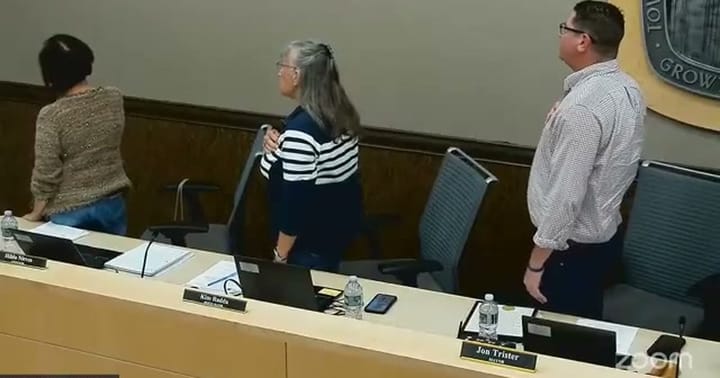
Town Council · Meeting of September 8, 2026
Newington's Town Council signaled it won't pursue a senior housing project on open space at 40 Mill Street Extension after sustained resident pushback. Mayor Jon Trister said "it's not going to be started," rejecting a Newington Housing Authority plan for 12 to 15 state-funded senior units on the 2-acre parcel. Residents Tom Dunn, Jeff Zelek and Laura Rzeszutek submitted letters arguing the town had promised to preserve the land and noting the town rejected the same site for an Emergency Operations Center in 2024 over identical concerns.
Separately, the council voted unanimously to partner with developer Tony Margiotta on a state brownfield grant, with no town cash match, to remediate the former Esquire Cleaners site at 450 New Britain Avenue for shared parking and EV charging; the grant application is due September 9. Councilors also heard that the MDC now charges new developments $11,100 per unit to offset storm water entering the sewer system, a fee already assessed at $87,000 on one Lewis Street project.
In the full story:
- Who Was There
- Organizations And Documents Referenced
- The complete report — 3,243 words
Source: the Town Council meeting of September 8, 2026, reported from the official video recording and transcript.
Checked against the record: before publication this article was automatically compared with the meeting transcript. It was corrected where it differed.
The Full Article
Teacher and Paraeducator of the Year Proclamations
The council opened with its annual recognition of Newington Public Schools' top honorees: pre-K teacher Kimberly DePaolis of John Paterson Elementary School, named 2026-2027 Teacher of the Year, and Sandra Periera, a paraeducator at Elizabeth Green Elementary School, named the district's first-ever Paraeducator of the Year. Both proclamations passed by unanimous voice vote with no debate. Superintendent Dr. Maureen Brummett's written statement, read into the record, credited DePaolis with "a passion for her work, ability to inspire learning in our youngest students." Elizabeth Green Principal Kevin Duran and Patterson Principal Matt Cray both spoke in support of the honorees, with Duran calling Periera "an asset to the Newington Public Schools" and Cray noting he had learned of her reputation within 30 days of joining the district. These items consumed about 20 minutes but produced no policy outcome beyond the honorary resolutions.
Stormwater and the MDC's Equivalent Inflow Removal Rate
Background and stakes: The Metropolitan District Commission, which operates Newington's sanitary sewer system, adopted a new ordinance effective January 2026 creating the Equivalent Inflow Removal Rate, a financing mechanism to pay for removing storm water that enters the sanitary system through sump pumps and foundation drains rather than leaky pipes. The town engineer's presentation was requested by the town manager's office to explain how the fee affects Newington specifically.
The question before the body: whether and how the new MDC surcharge affects new development review, with no vote required.
Substantive content: The engineer, introduced only as "Chris," explained that storm drainage systems are generally designed for a 25-year storm event — a 4 percent annual probability, roughly six inches of rain in 24 hours. He said Newington recorded 11 storms in 2023 that exceeded even the rarer 500-year threshold of two inches of rain in 30 minutes. MDC data show Newington's dry-weather sewer flow averages 3 million gallons per day, compared with 17 million gallons during wet weather — water the MDC must treat even though it isn't sewage. The new fee is set at $11,100 per "equivalent unit," defined as 1,996 gallons per day, and currently applies only to new development. The engineer cited a recent example: an affordable-housing project on Lewis Street was assessed $87,000 under the new fee, in addition to its standard connection fee, because the parcel previously had no structure on it. Older in-progress projects such as Meadow Commons and Cedar Point were approved before the January 2026 effective date and were not charged.
The deliberation: Councilor Gail Budrejko questioned how much buildable land remains in town, pointing to the roughly 90-percent-built figure and arguing undeveloped parcels such as the Hartford Hospital property remain a wild card. The engineer agreed MDC fee revenue is required to stay in Newington rather than flow to other member towns, a point he said was negotiated specifically because member towns worried about subsidizing each other's infrastructure. Councilor Kathy Gonzalez and Councilor Nancy Cappello both asked whether the fee could eventually be extended to existing single-family homeowners; the engineer said it currently is not, but he is "weary" that it could change by ordinance amendment. Councilor Kelly deHaas asked about a separate MDC pilot program targeting the Carr Avenue pump station sewer shed, roughly 112 streets and 150 houses, where MDC is studying whether storm water could be redirected into the town's storm sewers instead of the sanitary system; the engineer said MDC's consultant is now modeling Newington's pipe network using town GIS data he shared about a month before the meeting.
Procedural steps and outcome: This was a presentation only; no motion or vote was taken.
Implications and what is next: MDC's pilot study, which has no fixed completion date, could eventually allow the town to connect residential sump pumps to storm sewers rather than the sanitary system townwide, a change the engineer said could remove 14 million gallons per day of rainwater from treatment during storms. Any expansion of the fee to existing homeowners would require a new MDC ordinance.
Cedar Street Sidewalk Project Update
Background and stakes: The town is pursuing a state-funded sidewalk extension on Cedar Street between Maple Hill Avenue and Vincent Street, separate from a Connecticut Department of Transportation sidewalk project already under construction elsewhere on the same road.
The question before the body: whether the council has any objection to the town proceeding with design after a September 1 public information meeting.
Substantive content: The engineer said 20 to 25 people attended the session and that most in-person attendees opposed the project, while five or six written and phone comments received beforehand favored it. The most common objections were the burden of snow removal on homeowners who currently have no sidewalk obligation, and concerns that adding pedestrians to a street with frequent speeding and crashes could increase casualties rather than reduce them. The design would run on the south side of the street to avoid an estimated three-foot grade difference that would otherwise require a retaining wall, and would require a new pedestrian signal at the Vincent Street crossing; the existing signal at Maple Hill would remain the primary crossing point. Walks would be built five feet wide, a foot wider than standard, to accommodate both pedestrians and bicycles given the absence of a dedicated bike lane.
The deliberation: Deputy Mayor Kim Radda said she personally canvassed the area after the meeting and found a majority of residents she spoke with supportive of the sidewalk, citing pedestrian exposure to traffic. Councilor Gail Budrejko said she would prefer to see traffic-calming measures on Cedar Street addressed before adding pedestrian infrastructure, while also asking about a roundabout at the Vincent Street intersection; the engineer said he supports roundabouts in principle but said Cedar Street's intersection would likely require the town to acquire adjoining houses to build one properly, and that Cedar Street is a state road requiring Connecticut Department of Transportation involvement. Councilor Kathy Gonzalez asked for clarification on who is responsible for snow removal on sidewalks generally; the engineer confirmed it is standard practice statewide for abutting property owners, with limited town-maintained exceptions.
Procedural steps and outcome: No vote was taken. The engineer said that absent council objection, design work will continue toward construction; a council vote would be required only to stop the project and return grant funding.
Implications and what is next: The design phase continues without further council action required unless a member moves to halt it. The related SS4A federal safety grant for broader Cedar Street improvements has not yet been implemented, according to Councilor Budrejko.
Public Participation: The 40 Mill Street Senior Housing Dispute
Background and stakes: At the Newington Housing Authority's August 11 presentation to the council, Executive Director Melinda Harvey proposed using the state's Small Housing Authority Rental Expansion Program (SHARE) to build 12 to 15 single-story, cottage-style senior units on a 2-acre, town-owned, open-space-zoned parcel at 40 Mill Street Extension. The state would fund construction; no town money would be required. The parcel is deeded open space adjacent to existing Housing Authority senior housing and overflow parking for the Senior Center. Newington's draft SHARE application identified the site as an "expansion" of the Housing Authority's existing elderly housing program at 1-26 Mill Street Extension.
The question before the body: whether the council would authorize the project to advance to the Town Plan and Zoning Commission for a zoning change and a 99-year ground lease.
Substantive content: Three written submissions were read into the record by Rhines at Tuesday's meeting because they arrived too late for the August 18 meeting's minutes. A joint letter from Tom Dunn and Jeff Zelek argued that Public Act 25-1, Section 27 permits SHARE grant funds to be used for land acquisition on larger parcels, not just construction, and cited the Housing Authority's own 2020-2026 plan identifying larger candidate sites — the former Cedarcrest Hospital/Russell Road property, the former I-291 right-of-way, the Day Street/Fast Trak area and Town Center East — none of which included the Mill Street parcel. The letter noted that in 2024 the town eliminated 40 Mill Street from consideration for an Emergency Operations Center specifically because of "the potential impact to the senior housing and surrounding neighborhoods, and the reduction of town-owned greenspace." A separate letter from Laura Rzeszutek, a lifelong resident who grew up playing in the fields near Welles Drive, objected to what she called the town "going back on its word" that the parcel would remain open space in perpetuity. A third letter from Zelek made the same 2024-versus-2026 comparison regarding the town's 2024 purchase of 28 Garfield Street.
In person, residents Tom Dunn, Dana Havens, Rose Lyons, Louis of Churchill Drive and Lou Lloyd offered a range of views: several said they support senior housing in principle but object to using the last significant open parcel in that neighborhood, while Lyons and Lloyd argued the town has already quietly built on open space elsewhere and lacks any obvious remaining site for senior housing.
The deliberation: Mayor Trister, who had missed the August 11 meeting, said he reviewed it afterward and found there had not been "a unanimous consensus" among councilors on the project. He said the Housing Authority is "its own independent entity" separate from the town, and that presentations the council hears do not automatically become action items. Majority Leader Plourd thanked Dunn and Zelek for their "thoughtful letter," said he had walked Wells Drive and Wells Drive North and talked with many residents, and emphasized the need to balance essential housing with open space preservation. Councilor Tiniakos said the council needs "further discussion" and a way to balance both needs. Councilor Budrejko, who said she served on the committee that originally secured the Mill Street parcel's open-space zoning, argued "we had to fight and fight and fight" for what protections exist and said the fight justified the council's caution now.
"As far as putting a pause on something, we never started it. So we can't pause it because it hasn't been started. And it's not going to be started." [01:46:13] — Mayor Jon Trister
Procedural steps and outcome: No motion was offered or voted on regarding the Mill Street proposal; it was never scheduled as a formal action item. Trister's remarks served as the council's de facto answer to the public comments.
Implications and what is next: Acting Town Manager Lauren Rhines told the council that she, the acting town planner and the Housing Authority met the morning of September 8 to discuss "a connection for a potential different project in town" and that she would report back when appropriate. No site, timeline or cost estimate was identified.
Council Response: Open Space Protections and Rules of Procedure
Several councilors used the public-comment response period to address two other threads raised in written correspondence: proposed Rules of Procedure changes regarding councilor email forwarding and profanity in public correspondence, and the strength of the town's open-space zoning. Councilor Tiniakos said letters containing profanity will still be read into the record, just not verbatim, with offending words redacted at the reader's discretion. On open space, Councilor Budrejko said the Open Space Committee has discussed strengthening protections at its last two meetings and may examine conservation easements or supermajority requirements for any future rezoning of protected parcels. Majority Leader Plourd said he supports exploring conservation easements as a more durable, judicially enforceable protection than the current municipal zoning designation.
Old Business: Brownfield Grant for 450 New Britain Avenue
Background and stakes: The Department of Economic and Community Development's Municipal Brownfield Grant Program funds remediation of contaminated sites through public-private partnerships, with the municipality as applicant and pass-through entity. Developer Tony Margiotta, who owns the adjacent property housing Giovanni's Bakery, proposed remediating the former Esquire Cleaners site at 450 New Britain Avenue, contaminated for decades, and converting it into shared parking with electric-vehicle charging, secured bicycle parking and a pedestrian easement connecting to a planned gazebo behind Fire Station 5. Margiotta presented details at the August 11 meeting; the September 8 agenda item was the formal authorizing resolution.
The question before the body: whether to authorize a partnership with 450 NB Ave Redevelopment Partners LLC to apply for the state grant.
Substantive content: The resolution specifies no cash match is required from the town and empowers Acting Town Manager Lauren Rhines to execute related state documents. The state grant program caps awards between $200,000 and $6 million; Margiotta told the council on August 11 that remediation costs would likely reach "seven figures." The application deadline under the state's Round 24RG notice is noon, September 9, 2026, one day after the council's vote.
The deliberation: No council discussion occurred at the September 8 meeting; the resolution passed on a single motion and second.
Procedural steps and outcome: Approved unanimously by voice vote, with Lauren Rhines authorized to sign documents on the town's behalf.
Implications and what is next: The town must submit its grant application by the September 9 deadline. State award decisions are expected in November or December 2026. Margiotta has said he hopes to begin construction in summer 2027 to coincide with the town's broader New Britain Avenue streetscape project.
Old Business: BOE Behavioral Analyst Position and Rules of Procedure Revisions
The council approved, without discussion, a new A-5 classification job description for a Board Certified Assistant Behavioral Analyst position for the Board of Education, a role discussed in detail at the August 11 meeting by Director of Talent Management Talisha Foy, Board of Education Chief Finance and Operations Officer Lynn Boisvert and Assistant Director of Special Education Alexandra Heslin. The position, with a proposed salary range of $60,000 to $62,500, is intended to support the district's four existing Board Certified Behavioral Analysts and reduce reliance on costly out-of-district student placements, which Foy said cost about $225,000 per student annually. The council separately approved revisions to Sections 13 and 14 of its Rules of Procedure, governing donations/grants reporting thresholds and written public correspondence, following work by a subcommittee of Deputy Mayor Radda, Councilor Nieves and Councilor Budrejko. Both items passed unanimously with minimal discussion.
Resignations, Appointments, Tax Refunds and Minutes
The council accepted the resignation of Timothy Manke as a public member of the Town Pools Public Building Commission, effective September 8, 2026, tied to his separate appointment that same night as the Republican representative from the Board of Parks and Recreation to the same commission, filling a vacancy created by Carol Anest's earlier resignation. Dana Havens was simultaneously appointed as a public member to the commission, replacing Manke in that seat, for a term running to January 1, 2050. The council also approved $18,186.10 in property tax refunds and accepted the minutes of the August 11 and August 18, 2026 meetings. All items passed unanimously without substantive debate.
New Business: Board and Commission Review Subcommittee
A council subcommittee reviewing roughly 17 town boards and commissions recommended disbanding three inactive bodies: the Affordable Age Restricted Housing Study Committee, dormant for roughly a decade; the Newington Housing Needs Study Committee, whose narrow original charge the subcommittee said should be replaced by a broader successor committee; and the Permanent Municipal Building Committee Ordinance Review Subcommittee, whose work is now complete. No vote was taken; Councilor deHaas asked whether the Permanent Municipal Building Committee's authority might eventually be consolidated across all town building projects, and Majority Leader Plourd, who chaired the PMBC ordinance review with Deputy Mayor Radda, said he was comfortable with the ordinance as written but open to further discussion. The subcommittee will report back on the housing study question after confirming its original mandate with the Town Clerk's office.
Town Manager and Council Reports
Acting Town Manager Lauren Rhines reported the swearing-in of new Fire Marshal John Hoffman, two new police recruits beginning at the Police Academy in New Britain, and continued coordination with the Housing Authority on an alternative housing site. Councilors reported on a Planning and Zoning Commission hearing on an industrial rezoning proposal that drew neighborhood opposition, ongoing work on the $2 million Town Center Master Plan implementation, and the Open Space Committee's identification of parcels that could qualify for a state open-space acquisition grant requiring matching funds. Councilor Budrejko noted the town's upcoming 25th anniversary commemorations of the September 11 attacks, to be hosted by the Newington Volunteer Fire Department. The council also discussed, without voting, a request for guidance from the Town Pools Public Building Commission, which says both town pools need significant repair work and has asked the council to consider a special budget appropriation, and accepted information regarding a private committee's offer to donate funds for long-term maintenance of the Cherish Our Angels statue at West Meadow Cemetery.
WHO WAS THERE
Jon Trister, Mayor, presided Kim Radda, Deputy Mayor Matthew Plourd, Majority Leader (transcribed variously as "Floyd" and "Plot"; see review note) Gail Budrejko, Minority Leader Nancy Cappello, Member Kelly deHaas, Member Kathy Gonzalez, Member Hilda Nieves, Member A.J. Tiniakos, Member No absences were noted in the transcript; all nine roster members appear to have spoken during the meeting.
Lauren Rhines, Acting Town Manager Town Engineer identified only as "Chris" in the transcript (surname unconfirmed; see review note) Talisha Foy, Director of Talent Management, Newington Board of Education Lynn Boisvert, Chief Finance and Operations Officer, Newington Board of Education Alexandra Heslin, Assistant Director of Special Education, Newington Board of Education Kevin Duran, Principal, Elizabeth Green Elementary School Matt Cray, Principal, John Paterson Elementary School
Public commenters: Tom Dunn, 75 Welles Drive; Dana Havens, 113 Stoddard Avenue; Louis, 482 Churchill Drive (identified with "Magnified Home Inspection," no surname given); Lou Lloyd, 21 Hartford Avenue; Bob Taller, 32 Edmonton Street; Rose Lyons, 46 Elton Drive.
Written correspondence read into the record from: Tom Dunn and Jeff Zelek (joint letter); Laura Rzeszutek; Jeff Zelek (second letter).
Outside parties referenced but not present at the September 8 meeting: Melinda Harvey, Executive Director, Newington Housing Authority (presented the Mill Street proposal August 11); Tony Margiotta, developer and owner of Giovanni's Bakery (presented the brownfield proposal August 11).
ORGANIZATIONS AND DOCUMENTS REFERENCED
Metropolitan District Commission (MDC) — the regional sewer authority whose new Equivalent Inflow Removal Rate ordinance was the subject of the engineer's presentation. Connecticut Department of Economic and Community Development (DECD) — administers the Brownfield Municipal Grant Program cited in the New Britain Avenue resolution. Connecticut Department of Housing — source of SHARE program grant funding discussed in connection with the Mill Street proposal. Newington Housing Authority (NHA) — independent entity that proposed the 40 Mill Street senior housing project. 450 NB Ave Redevelopment Partners LLC — private entity named in the brownfield grant resolution. Public Act 25-1, Section 27 — cited in resident correspondence as authorizing SHARE grant funds for land acquisition, not just construction. MDC EIRR ordinance, effective January 2026 — cited by the town engineer as the basis for the $11,100-per-unit fee. DECD Brownfield Municipal Grant Program Notice of Funding Availability, Round 24RG, dated July 15, 2026 — sets the September 9, 2026 application deadline cited in the brownfield discussion. Newington 2021-2026 Affordable Housing Plan — cited by resident Rose Lyons as having previously identified housing strategies the town has not fully executed. NHA Plan 2020-2026 — cited in resident correspondence as identifying larger housing sites that bypassed the Mill Street parcel. Town Council Rules of Procedure, approved July 28, 2026 — subject of the Sections 13 and 14 revisions approved September 8.
Share this story
Know someone in Newington who follows town government? Share Townbrief Newington: they can sign up free.