Flag Subcommittee Elects Chair, Delays Policy Vote
Newington's flag policy subcommittee elected leaders and put off any decision on a permanent flag policy. Members Hilda Nieves and Nancy Cappello were chosen chair and vice chair by unanimous voice vote, with Kathy Gonzalez the panel's third member.
Town Council · Meeting of October 19, 2026
Newington's flag policy subcommittee elected leaders and put off any decision on a permanent flag policy. Members Hilda Nieves and Nancy Cappello were chosen chair and vice chair by unanimous voice vote, with Kathy Gonzalez the panel's third member. The group, formed after a July 28 moratorium on non-official flags including the Pride flag, compared roughly a dozen towns' ordinances, from Manchester's application-based approach to Enfield's and Wethersfield's official-flags-only rules.
One member said "I don't want to go around in circles," while another said she was "not ready to come to any kind of a decision right now." A resident, identified only as Peter, told the panel a June 2026 request to read the town attorney's legal opinion into the record "I don't think it ever has been" fulfilled. The subcommittee scheduled its next sessions for December 14 and January 11, both at 5 p.m.
In the full story:
- Who Was There
- Organizations And Documents Referenced
- The complete report — 1,954 words
Source: the Town Council meeting of October 19, 2026, reported from the official video recording and transcript.
Checked against the record: before publication this article was automatically compared with the meeting transcript.
The Full Article
Call to Order and Election of Officers
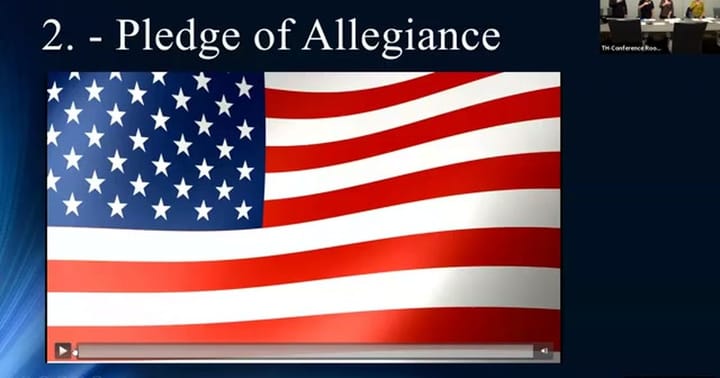
The Town Council's flag policy subcommittee opened its first working meeting at 5:03 p.m. with the Pledge of Allegiance and an election of officers. This subcommittee exists because the full Town Council, on July 28, imposed a moratorium on flying non-official flags on town property while a dedicated panel "evaluates and drafts a permanent policy," as the group's chair described it at the outset. The question before the body at this stage was purely organizational: who would lead it.
Member Hilda Nieves was nominated for chair from the floor and elected by unanimous voice vote with no competing nominations. Member Nancy Cappello was then nominated for vice chair and elected the same way. Member Kathy Gonzalez rounds out the three-person panel; no other Town Council members serve on this subcommittee. The procedural step consumed about two minutes and set the leadership that ran the remainder of the meeting, with Nieves presiding as chair.
Public Participation, Opening Round
Before turning to substantive business, the subcommittee opened the floor to two remote public commenters. Dana Havens, who gave her address as 113 Stoddard Avenue, told the panel she wanted "to maintain peace, camaraderie, comfort within the town" by restricting town flagpoles to municipal, state and federal government flags only. No other hands were raised in the opening round, and the chair noted that a second unidentified individual online had not activated a hand-raise function and could use a phone star-nine command to be recognized, but no one did so at that point.
Background and the Shape of the Flag Policy Problem
The chair opened the substantive discussion by distinguishing "official" flags Newington flies as a matter of course, the U.S. flag, the Connecticut state flag, municipal flags and the POW/MIA flag, from "unofficial" flags that have become a source of town debate. She traced the current controversy to the Pride flag, which the town has flown for what one member described as a third consecutive year, as distinct from an organ-donor awareness flag and a 250th-anniversary commemorative flag, both of which one member said drew no public objection when raised. One member summarized the dynamic bluntly: "The reason we're sitting at this table is because of the pride flag... When the donor flag was raised, there was not one problem on council level, on community level. Everyone was supportive... And it was when the pride flag was raised, all of a sudden, huge issues came about." A colleague added that the deeper issue was procedural as much as substantive: a resident had flown a flag "alongside the flag" without any council vote or public acknowledgment, and that lack of process, not any single flag, is what she identified as the real trigger.
The question before the subcommittee at this meeting was not to adopt language but to decide what information it still needs before it can. Members spent the bulk of the roughly 50-minute discussion comparing how other Connecticut municipalities regulate flagpoles and identifying gaps in their own research.
Comparing Municipal Practices
Members had compiled a written list, apparently drawn in part from an Office of Legislative Research report supplied to the committee, cataloging roughly a dozen towns' practices. Towns identified as limiting flagpoles to official government flags only included Enfield, Southington, Suffield, Darien, Cheshire, New Canaan and Wethersfield; members noted that both Enfield and Wethersfield changed their practices to this more restrictive stance within the past few years, following legal challenges. Towns identified as allowing broader or varying flag displays included New Haven, East Hartford, Hartford, Middletown, Easton, Manchester, New Britain, South Windsor and Berlin, though one member disputed whether West Hartford belonged on that list, illustrating a recurring friction point: members disagreed about how reliable their secondhand lists were. One member said she had done her own quick search and "didn't have a couple of the ones you had," and asked "where we can find like a truly accurate" accounting of other towns' policies.
Manchester's ordinance drew the most detailed discussion. One member read its text aloud: Manchester "allows unofficial, i.e. commemorative and organizational flags on designated flagpole upon request to and approval by the board of directors," while excluding flags tied to "a particular religion, political party, business" or any flag that would "enable violence, discrimination, prejudice, or racism." Another member flagged that exclusion as a point worth examining closely, asking whether such content-based screening "would be discriminatory" in its own right, a concern she said made her want to look further into how Manchester applies the standard in practice. Berlin's ordinance was also cited as permitting specific commemorative categories, including "thin blue line" and "thin red line" flags and flags tied to September 11 remembrance, which members said illustrated how granular these policies can get.
The Core Disagreement: How Much More Research Is Needed
The sharpest exchange of the meeting was less about which flags should fly than about whether the subcommittee already has enough information to move toward a draft. One member, citing the written materials already compiled, argued the panel should stop collecting comparisons and decide what is right for Newington on its own terms: "What do we want to do as Newington? Do we want to subject ourselves to lawsuits in the future? Or do we protect ourselves and just stick to official flags?" She noted the panel already had "one, two, three, four, five, six, seven, eight towns here" in writing and asked rhetorically, "How many more do you need?"
A second member pushed back, saying she was "not ready to come to any kind of a decision right now" and wanted direct conversations with peer towns about what controversies, if any, followed their policy choices, plus outreach to residents. "I want to know more about the residents. I want to hear residents' feedback," she said, floating the idea of a public forum. A third member occupied a middle position, agreeing a policy is necessary but wanting clarity on the town attorney's guidance and the mechanics of implementation, including whether unofficial flags would require a second flagpole separate from the one flying the U.S. and state flags, since federal flag protocol bars placing any flag below or touching the U.S. flag on the same pole.
Members agreed, without formal vote, on a short list of fact-finding steps: consult the superintendent of schools, since the Board of Education may set its own policy for flags displayed inside classrooms separate from any outdoor town flagpole policy; consult the Parks and Recreation Department, which manages a town sign board and related outdoor-display practices; and reread the town attorney's existing written guidance, which multiple members said recommended Newington adopt a flag policy but keep it "as limited as possible," citing a U.S. Supreme Court decision involving the city of Boston as the legal backdrop driving towns nationally toward narrower policies. An unidentified staff member present, referred to in the meeting only as James, offered to share the request with a statewide association representing roughly 168 other municipal officials to collect other towns' policies and any controversies they encountered.
Public Participation, Closing Round, and Pushback on Process
Two residents spoke again near the end of the meeting, after the subcommittee had worked through its substantive discussion. A commenter identified only as Peter, who gave his address as 309 Candlewick Drive, told the panel he had raised the flag-policy question at the June 23 Town Council meeting, when he said the town's former town manager, referred to in the discussion only by the first name Jonathan, had already requested and received a legal opinion recommending a limited policy, citing the Boston Supreme Court case. Peter said he had asked at that June meeting that both his request and the legal opinion be read into the public record, and said that still had not happened: "I don't think it ever has been." He urged the panel to focus on what is right for all of Newington rather than tallying other towns' practices: "It's what's right for Newington... You need to make decisions for Newington and what's best for Newington and all of Newington."
Dana Havens returned to clarify a factual point for member Kathy Gonzalez, noting that the 250th-anniversary flag is in fact an official U.S. flag, having been authorized by Congress in May of this year. Havens also cautioned against holding an open public forum on the topic, saying the same small group of residents tends to speak on both sides of the issue at council meetings, and suggested council members who want to express a personal cause use a lapel sticker or desk flag rather than the town flagpole. One member responded directly to the public comments, acknowledging she could not yet make a decision and wanted to understand why other towns' policies have or have not worked before committing to an approach for Newington.
Scheduling and Procedural Close
With no agreement on policy language, the subcommittee turned to logistics. Members agreed to meet next on Monday, December 14, 2026, at 5 p.m., and again on Monday, January 11, 2027, at 5 p.m., after ruling out November due to a member's unavailability and MLK Day conflicts with a later January date. Both dates were approved by unanimous voice vote on a motion from the floor. The staff member present said the room would be reserved and the dates added to the subcommittee's annual meeting schedule, due to be finalized February 1. The subcommittee then closed public participation and adjourned at 5:56 p.m. on a unanimous voice vote.
Implications and What Is Next
The moratorium on non-official flags, including the Pride flag, stays in effect at least through the panel's December and January meetings. No draft policy language exists yet; the subcommittee's next substantive task is to incorporate input from the superintendent of schools and Parks and Recreation before it can present any recommendation to the full Town Council.
WHO WAS THERE
Hilda Nieves, elected chair of the Flag Policy Subcommittee at this meeting.
Nancy Cappello, elected vice chair of the Flag Policy Subcommittee at this meeting.
Kathy Gonzalez, member, Flag Policy Subcommittee.
James, town staff present to assist with scheduling; surname and formal title not given in the available sources.
Dana Havens, resident of 113 Stoddard Avenue, public comment (participated twice, remotely).
Peter, resident of 309 Candlewick Drive, public comment (surname not clearly captured in the transcript).
ORGANIZATIONS AND DOCUMENTS REFERENCED
Town Council of Newington — imposed the July 28, 2026, moratorium on non-official flags and created this subcommittee to draft a permanent policy.
Office of Legislative Research (OLR) — cited as the source of a report comparing Connecticut municipalities' flag policies and Board of Education flag advisories, supplied to subcommittee members.
Manchester, Connecticut flag policy — discussed in detail as a model allowing unofficial flags by application with specific content exclusions.
Enfield and Wethersfield flag policies — cited as examples of towns that moved to official-flags-only policies after legal challenges in recent years.
Town Attorney (unnamed in transcript) — provided written legal guidance recommending Newington adopt a limited flag policy, cited repeatedly by members.
U.S. Supreme Court decision involving the city of Boston — referenced by multiple speakers as the legal precedent driving municipalities toward restrictive flag policies; not named by case title in the transcript.
Superintendent of Schools, referred to as Dr. Bremen — to be consulted on the Board of Education's separate authority over classroom and school-building flag displays.
Parks and Recreation Department — to be consulted on town sign-board and outdoor-display practices relevant to a possible second flagpole.
Statewide municipal association (unnamed) — offered by staff member James as a channel to collect other towns' flag policies and experiences.
Share this story
Know someone in Newington who follows town government? Share Townbrief Newington: they can sign up free.