Panel recommends disbanding social media committee
A Newington Town Council subcommittee voted to recommend disbanding its dormant Social Media Policy Subcommittee while tabling action on an LGBTQI+ Plus Committee. Deputy Mayor Kim Radda, Councilor Kelly deHaas and Councilor A.J.
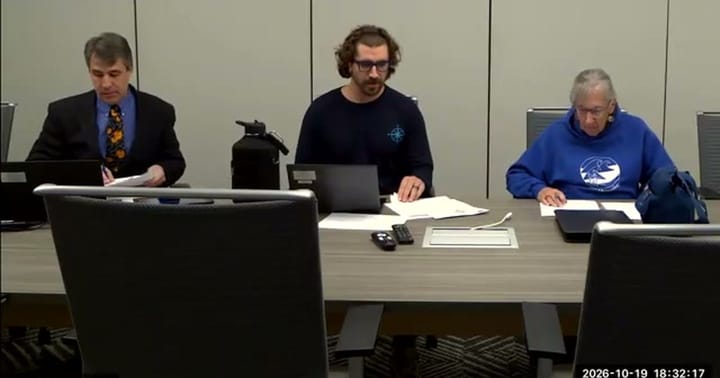
Town Council · Meeting of October 19, 2026
NEWINGTON — A Newington Town Council subcommittee voted to recommend disbanding its dormant Social Media Policy Subcommittee while tabling action on an LGBTQI+ Plus Committee. Deputy Mayor Kim Radda, Councilor Kelly deHaas and Councilor A.J. Tiniakos, the subcommittee's three members, heard from town staff that the LGBTQI+ Plus Committee, created by resolution in July 2024, was never legally formed because the town charter requires an ordinance for permanent committees.
Staff member James said an outside agency has since absorbed the committee's intended roles, but members chose to table disbandment to discuss the history in their caucuses first. The social media policy work, meanwhile, was quietly completed via an administrative letter under the town manager's office that was "never presented to the council," James said. Tiniakos called the existing policy "solid." Members also approved minutes and added meetings for December 7, 2026, and January 4 and 25, 2027.
In the full story:
- Who Was There
- Organizations And Documents Referenced
- The complete report — 1,846 words
Source: the Town Council meeting of October 19, 2026, reported from the official video recording and transcript.
Checked against the record: before publication this article was automatically compared with the meeting transcript.
The Full Article
Call to Order and Roll Call
The Town Council's Subcommittee to Review Committees convened at 6:31 p.m. with a quorum of three members: Deputy Mayor Kim Radda, Councilor Kelly deHaas, who participated remotely, and Councilor A.J. Tiniakos. No members of the public attended in person or online. The subcommittee exists to work through a list of boards, commissions and committees that staff and council members believe may be inactive, duplicative or improperly formed, with an eye toward recommending disbandment, consolidation or ordinance changes to the full council.
Social Media Policy Subcommittee
Background and stakes: The Social Media Policy Subcommittee was created by council resolution in 2017 to develop guidance on social media conduct for town employees and elected officials. It met a handful of times, discussed policy language, and then stalled. The council at the time, according to town staff member James, "chose to sort of let the whole process drop" because the subject proved difficult to manage. Around 2024, after Town Manager Jonathan and Assistant Town Manager Lauren joined the administration, the town manager's office developed and implemented a social media policy through an internal administrative letter, bypassing the subcommittee and the council entirely.
The question before the body: Whether to recommend that the full council formally disband the subcommittee, given that its original task was effectively completed outside the committee structure.
Substantive content: James told members the administrative letter addresses balancing employee and elected-official conduct against First Amendment protections, and that it was modeled on policies from surrounding towns. He confirmed the letter was never presented to the council for review or adoption. Councilor Tiniakos said he had read the policy in advance of the meeting and found it adequate: "I read the social media policy last week. I thought it was solid. I thought that it encompassed a lot." He added that he did not think the policy needed formal council approval, calling it "more of a personnel matter anyways." Deputy Mayor Radda raised a process concern, noting the subcommittee technically remains "on the books" as an active committee even though its work was absorbed elsewhere: "So that was created, but I feel like we've still got this committee or subcommittee hanging out there."
The deliberation: Members agreed the cleanest path was not simply to let the subcommittee fade from memory but to formally close the loop. Radda suggested presenting the administrative letter to the full council alongside the disbandment recommendation "so that, you know, something's in place. There's closure." Tiniakos agreed, adding that council members themselves have never been shown the policy that applies to them: "I know it's like step one, two, three, four... if the policy applies to people on the council, we should be aware of where the policy is." DeHaas, reached for her view by phone, said simply, "I'm with you on this one."
Procedural steps and outcome: A member moved to present the disbandment of the Social Media Policy Subcommittee at an upcoming council meeting; the motion was seconded and approved without objection by the three-member panel.
Implications and what is next: The recommendation now goes to the full Town Council, which would need to take its own vote to formally dissolve the subcommittee and, potentially, review the administrative social media letter for the first time.
LGBTQI+ Plus Committee
Background and stakes: The LGBTQI+ Plus Committee was created by council resolution in July 2024, memorialized in the minutes of the July 20, 2024 meeting. James told the subcommittee that under the town charter, permanent committees must be created by ordinance, not resolution, a procedural defect that has left the committee without any appointed members beyond a staff liaison, Carol LeBrak.
The question before the body: Whether to recommend disbanding the committee given that an outside agency has since taken over much of its intended function, and if so, how to proceed given the unresolved legal-formation issue.
Substantive content: James said the individual who originally proposed the committee has since told the town that an outside agency has absorbed most of its anticipated roles and indicated that disbandment "would be appropriate." He noted the committee does not appear on the town website because it was never given technical membership. Citing the charter directly, James read: creation of "boards, commissions, departments, agencies, offices, and alternate members of boards and commissions" must be done "by ordinance" under charter chapter 610. "The charter itself specifically calls out that creation of permanent committees are done by ordinance," he said, confirming that no resolution-created appointments to the committee were ever legally valid.
The deliberation: Radda asked James whether this was the committee with concerns about the legality of its formation, distinguishing it from a similarly flagged "cultural committee." James confirmed the LGBTQI+ Plus Committee had the same defect: it arrived as a resolution, the issue was flagged to the town manager at the time, and "nothing ever moved forward with it." Given the sensitivity of disbanding a committee tied to an underrepresented community, a member said she preferred not to send a disbandment recommendation straight to the full council without first discussing the history and context within party caucuses: "Knowing some of the history behind this... my recommendation would be to not present this at the next council meeting, but provide that timeframe to discuss it within our caucuses first." No member objected to the delay.
Procedural steps and outcome: A motion to table the LGBTQI+ Plus Committee disbandment question and refer the history to individual council caucuses was made and seconded. The subcommittee did not take a recorded vote count beyond the motion and second; there was no objection.
Implications and what is next: The committee remains formally unresolved. Council members will discuss its history in caucus before the subcommittee revisits the question, with no date yet set for that follow-up.
Open Space Committees and Related Ordinances
Background and stakes: Newington currently has two open space entities on its books. The original Open Space Committee was created around 2010-2011 in response to the Toll Brothers company's proposal to develop Cedar Mountain, specifically to pursue preservation of that and other parcels. A second, 2015 Open Space Committee was created once the town began acquiring parcels from the state, with a broader, "more nebulous" charge, according to James.
The question before the body: Whether and how to consolidate or expand the open space committee structure, and whether to revisit a previously tabled ordinance subcommittee on the topic.
Substantive content: James explained the 2015 committee operates differently from the original: rather than the committee recommending actions directly to the council, the council refers matters to the committee for review and report-back. He said the council has discussed expanding the 2015 committee's role across all town open space, and that a possible ordinance subcommittee on the subject was tabled at a recent council meeting. James confirmed the charter required ordinance-level action, not resolution, for both open space committees during their respective creation periods.
The deliberation: Radda indicated she did not want the review subcommittee to preempt or duplicate the council's separate, ongoing open-space discussion: "I don't want to step on anyone's toes." DeHaas agreed that any related ordinance work, including the Environmental Quality Commission, Conservation Commission and Open Space Commission's relationship to one another, should pause until the council's broader open-space discussion concludes: "I think anything having to do with open space right now should pause until we sort through that a little more and figure that out, see where we get."
Procedural steps and outcome: No vote was taken. Members agreed informally to wait on any ordinance changes tied to open space pending the outcome of the council's separate discussion.
Implications and what is next: The scope of the 2015 Open Space Committee, and whether it should be formally expanded by ordinance to cover town-wide open space decisions, remains an open council matter that will shape whether this subcommittee later proposes charter-compliant ordinance language.
Other Inactive or Nearing-Completion Committees
Several shorter items were covered briskly. The America 250 Commission is a state committee to which the town manager appoints an individual; it is not a town committee and falls outside the subcommittee's purview, James said, noting it will dissolve on its own once the governor's executive order establishing it expires. The Anna H. Reynolds Building Committee and a project referred to by a member as "John Wallace" were both described as nearing completion, with final reports expected to reach the council before the end of 2026. The Newington Facade loan program, created in 2003, is presumed inactive; James said he would research the underlying language further. The Newington Housing Partnership, referenced under old Newington Code Section 16-1 (pre-2008 recodification), is also considered inactive, and James said he would cross-reference it against the town's current code using the derivation table before reporting back. Members asked James to send a general inquiry to department heads asking whether any ordinances under their purview need updating, citing the 2016 blight review subcommittee as a past example of such a request.
Minutes Approval and Scheduling
The subcommittee approved minutes from its July 20, August 3 and August 17, 2026 meetings without changes, after an initial date mix-up over whether the July meeting was held on the 20th or 21st was corrected to the 20th. Members then added three meeting dates to their calendar beyond the already-scheduled November 16, 2026 session: December 7, 2026, and January 4 and January 25, 2027, with one member noting "fingers crossed" that the panel's work could wrap up as early as January. The meeting adjourned at 6:59 p.m. on a unanimous voice vote.
WHO WAS THERE
Deputy Mayor Kim Radda, Member, present. Councilor Kelly deHaas, Member, present remotely. Councilor A.J. Tiniakos, Member, present. James, town staff member assisting the subcommittee's review (title not stated in available sources), present. No members of the public attended in person or online; no outside parties or applicants appeared.
ORGANIZATIONS AND DOCUMENTS REFERENCED
Newington Town Charter, Chapter 610 — cited by James as requiring permanent boards, commissions and committees to be created by ordinance rather than resolution; central to the disbandment discussions for both the Social Media Policy Subcommittee and the LGBTQI+ Plus Committee. Social media administrative letter — the town manager's office's internal policy on social media conduct for employees and elected officials, implemented without council review; discussed in the Social Media Policy Subcommittee item. Minutes of the July 20, 2024 council meeting — cited as the source of the resolution creating the LGBTQI+ Plus Committee. Newington Code Section 16-1 (pre-2008 recodification) — cited regarding the inactive Newington Housing Partnership. 2016 Blight Review Subcommittee ordinance — cited by James as an example of an ordinance update driven by department-head input. Toll Brothers Cedar Mountain development proposal (circa 2010-2011) — cited as the origin of the original Open Space Committee. Anna H. Reynolds Building Committee — referenced as nearing completion, with a final report expected before year's end. America 250 Commission — a state-level committee referenced to clarify it is outside the town council's purview.
Share this story
Know someone in Newington who follows town government? Share Townbrief Newington: they can sign up free.