Panel recommends disbanding three dormant boards
Newington's Town Council review subcommittee moved to disband three dormant boards and flagged missing records on a $20 million school bond. Councilors A.J.
Town Council · Meeting of August 3, 2026
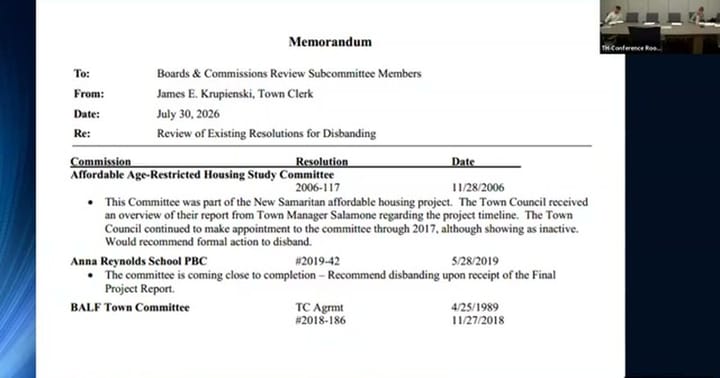
Newington's Town Council review subcommittee moved to disband three dormant boards and flagged missing records on a $20 million school bond. Councilors A.J. Tiniakos and Kelly deHaas, joined later by Kim Radda, agreed to recommend disbanding the Age-Restricted Housing Study Committee, the Newington Housing Needs Study Committee and the Permanent Municipal Building Commission Ordinance Review Subcommittee, all of which had completed their assigned work years earlier.
Staff presenter James told the panel he could find no final reports for any of ten school renovation projects tied to a 1998 committee that managed roughly $20 million in bonded construction, saying "it sounds as though there is no clear record of how it closed out." The panel also deferred decisions on a Balfe Town Committee membership dispute, a possible revival of the Joint Shared Services Committee with the Board of Education, and whether to formalize an unwritten 2025 social media policy, Administrative Letter 41.
In the full story:
- Who Was There
- Organizations And Documents Referenced
- The complete report — 2,211 words
Source: the Town Council meeting of August 3, 2026, reported from the official video recording and transcript.
Checked against the record: before publication this article was automatically compared with the meeting transcript.
The Full Article
Roll Call and Framing of the Review
The Town Council's Boards and Commission Review Subcommittee convened at 6:38 p.m. Monday, August 3, with Councilor A.J. Tiniakos and Councilor Kelly deHaas present and Councilor Kim Radda recorded absent at the roll call, achieving a quorum with two members. Radda appears to have joined partway through the session; later discussion refers to her directly by first name in a way that indicates her participation. No members of the public joined for the agenda-item comment period. A town staff member identified in the recording only as James led the meeting, having prepared a packet reviewing the history of nearly every standing committee, subcommittee and commission the town has created by resolution, going back to a 1989 committee tied to the Balfe agreement.
The subcommittee's task, as James framed it, was to work through decades of accumulated boards and commissions, identify which have completed their assigned work, and recommend which should be formally disbanded, reorganized into ordinance, or left as-is pending further council conversation. James said he had included draft recommendations in the packet but stressed, "that's not for me to decide on. I can only put forward my recommendations on things."
Housing Study Committees and PMBC Ordinance Review
The Age-Restricted Housing Study Committee, tied to a since-completed project across from Town Hall behind the senior center, has not received new appointments since 2017, James said. As a single-use study committee, its formal work ended once that project wrapped up, and James recommended disbanding it outright. The subcommittee agreed without objection.
The Newington Housing Needs Study Committee was adopted by resolution in 2014, predating the state's own entry into housing-needs studies; its report was submitted in February 2015. With the state repealing related statutory language this year, James said "there is no point for this commission to still exist," noting the town had already removed it from its public-facing boards and commissions list. The subcommittee agreed to disband it as well.
The Permanent Municipal Building Commission Ordinance Review Subcommittee, a short-lived body that reviewed proposed revisions to the commission's governing ordinance, was also marked for disbandment. One subcommittee member noted having served on that review alongside Majority Leader Matthew Plourd and a person identified only as Dave Nagel, recalling that the group worked "almost word by word" through concerns specific to the library and fire department, which both have unique membership needs under the ordinance.
Balfe Town Committee and Central Connecticut Health District
James described the Balfe Town Committee, created under a 1989 agreement, as a body that has been "active, inactive" over the years, with an ongoing problem: it does not formally present its membership to the council as the agreement requires. "They just have anybody they want show up when they feel like it, which is a problem, because you can't get any business done that way," James said. He recommended the council, or a small subcommittee of it, meet directly with Balfe representatives to revisit the 1989 agreement, which is now 37 years old.
On the Central Connecticut Health District, which Newington joined in 2006 after dissolving its own health department, James said he was uncertain how the district determined Newington's four-member allocation and planned to contact a CCHD official referred to only as Mr. Brown for documentation. He noted a reappointment for a CCHD board member referred to as Mr. McCarthy was scheduled for the council's August 11 agenda.
Facilities Naming, Fire Department and Library Building Commissions
The Town Council's Facilities Naming Committee has shifted positions repeatedly on whether to name buildings, streets or rooms after individuals, and is currently under a council-imposed moratorium while members review policy models. One subcommittee member said the committee is "in the process of looking at our committee policies" because naming now extends beyond buildings to streets and rooms, requiring more diligence.
James raised a more consequential question about the Fire Department Facilities Public Building Commission and the Library Renovation Public Building Commission. With the fire department project headed to a fall referendum, James asked whether the council should close that commission once the vote occurs and transfer oversight to the newer Permanent Municipal Building Commission, which carries standardized, trade-specific membership requirements. "Does it make sense to close that committee out at this point, put it to the full municipal commission and let it manage from there?" he asked, while cautioning the move "will cause some confusion" without an orderly transition process.
Tiniakos, who chairs the library renovation subcommittee and participated by videoconference, was noncommittal: "This one I'd probably have... we'd have to discuss this a little bit. I definitely need some input from a couple other people too to see which way they would want to go." He added he was "not a hard no" and acknowledged consolidating all three building-related bodies, including a separate town pools committee, would free up roughly twenty-one appointed volunteer seats across the three, but said members wanted to avoid acting "too haphazardly" given public interest in all three projects.
Housing Authority and Joint Shared Services
James flagged the Housing Authority, created under Connecticut General Statutes Section 8-41, as a body the council rarely hears from: it does not send agendas, minutes or annual reports to the council despite being a municipal commission. He noted Councilor Kathy Gonzalez has been attending as a liaison, though the council never formally created a liaison position for that body. James recommended reviewing the statute, which has accumulated amendments over the years regarding possible additional membership, particularly if the town pursues partnerships with the authority on senior housing, an area he said town survey data identified as a priority for residents.
The Joint Shared Services Committee, active intermittently since 2018 and essentially dormant for roughly three years, drew the most direct institutional memory from subcommittee members. One member recalled discussing reviving the committee during this year's budget cycle to work more closely with the Board of Education, including a long-stalled effort to get both the town and school district onto a single financial software platform. "That was one of the biggest reasons the committee was created," James said, "specifically to allow for an easier communication between the board of ed and ourselves in the financial package." Members agreed to hold off on a disbandment recommendation pending conversations with their respective caucuses about whether to revive the committee ahead of the next budget cycle.
Open Space Committee
James distinguished the Open Space Committee, created by resolution rather than as a study committee, as a body that currently can only act when the council directs it to evaluate a specific parcel. He suggested the council consider drafting a formal ordinance that would let the committee proactively research and recommend parcels for acquisition, drawing on criteria the council adopted in 2024 and modeled on practices in other towns. One subcommittee member said they were "open to having them actually take the lead on researching... and then coming to council," adding that residents interested in open space issues are likely frustrated waiting for the council to bring matters to them, particularly since the committee meets only quarterly under an existing land-protection pact.
School Code Compliance Committee and the $20 Million Bond Gap
The subcommittee's longest and most substantive discussion concerned prior disbandment practices, beginning with the School Code Compliance Committee. Created by resolution in 2008, the committee was assigned four additional projects in 2012: Newington High School tennis court and music wing work, a gym floor replacement, and the John Wallace Middle School public building commission abatement project. The council formally disbanded the committee in 2024 after a decade of inactivity, but James told the subcommittee he found no completion reports for any of the four projects. "I have not found a report for any of those, any of those projects whatsoever," he said.
James traced a broader pattern using the Downtown Revitalization Committee (created 2008 with a $1 million state bonding allocation, disbanded 2015 with a one-line resolution stating only that it had "completed its work as charged") and, most significantly, the Newington School Improvements Project Building Committee. That body, created in 1998, eventually oversaw ten separate projects across all seven town schools under a single roughly $20 million bond, including expansions at Anna Reynolds, John Patterson, John Wallace and Martin Kellogg schools, plus science labs, technology infrastructure and portable classrooms. James said the committee was formally disbanded through a 2015 resolution that referenced a different and only partially overlapping set of projects, including a high school track renovation and a Board of Education roof replacement.
"What happened to all the other projects?" one subcommittee member asked. James said he could not answer, adding he had searched council records without finding final reports, change orders or closeout documentation for most of the ten projects. He noted the town experienced a roof failure at Anna Reynolds roughly twenty years after a 1999 renovation, which he cited as evidence of what can happen when institutional knowledge about completed work is lost through administrative and council turnover.
A subcommittee member pressed on accountability: "I'm going to ask a question that probably doesn't need a response, but where has been the oversight all these years to not follow through and say, we need a final report, we need to close out?" James responded that the breakdown largely reflects administrative and council turnover over nearly three decades. "Transition... when people leave, that knowledge goes with them," he said, adding he has worked in three municipalities and seen the same pattern in each. He said the town's current tracking software lacks a clear field to record final project-report completion dates, something he intends to raise separately.
Members noted that under the newer Permanent Municipal Building Commission structure, a final project report accepted by the council will be a formal requirement before any future building project can be closed out, unlike the ad hoc arrangements that governed the 1998 and 2008 committees.
Consensus Summary and Next Steps
Near the end of the discussion, a subcommittee member summarized the group's position: agreement to disband the Age-Restricted Housing Study Committee, the Newington Housing Needs Study Committee, and the Permanent Municipal Building Commission Ordinance Review Subcommittee "without further conversation." James said he would draft a letter to Town Manager Jonathan Altschul documenting the recommended disbandments. The Joint Shared Services Committee and the Town Facilities Naming Committee were held for further caucus discussion, and the Social Media Policy Subcommittee, created by council Resolution 2017-36, was held pending review of Administrative Letter 41, the internal policy that a prior administration led by Altschul and an assistant town manager identified as Rheins issued in 2025 after the subcommittee's policy effort stalled. One member questioned whether an administrative letter issued by town staff could properly substitute for council action disbanding a body the council itself created: "If it was created by the council, wouldn't it be the council that would bring either another resolution forward or for approval to disband?" James agreed that formalizing the letter, rather than relying on it informally, would be the cleaner path and said he would distribute the three-page letter for review.
James said the subcommittee could realistically target three additional resolutions for action at its next meeting. Members agreed to consult party leaders and the chairs of committees still "on the fence" before that session. The meeting moved to a brief public comment period with no attendees, followed by council comments in which Tiniakos apologized for attending by videoconference and said he would arrange transportation for the next meeting. The subcommittee adjourned on a voice vote at approximately 7:40 p.m.
WHO WAS THERE
Councilor A.J. Tiniakos, member, present via videoconference. Councilor Kelly deHaas, member, present. Councilor Kim Radda, member, recorded absent at roll call, appears to have joined later in the meeting. James, town staff member, presented the boards and commissions review memo and led the discussion; no surname given in the transcript. No members of the public participated; the public comment period drew no attendees either in person or online.
ORGANIZATIONS AND DOCUMENTS REFERENCED
Central Connecticut Health District — regional health district Newington joined in 2006; discussed regarding board membership allocation and a pending reappointment. Balfe Town Committee / Balfe agreement (1989) — longstanding committee discussed for membership compliance issues. Newington Housing Authority — statutory body under Connecticut General Statutes Section 8-41, discussed regarding reporting gaps and liaison status. Board of Education — referenced throughout regarding the Joint Shared Services Committee and historical school construction committees. Permanent Municipal Building Commission (PMBC) — the town's newer consolidated building commission, discussed as the destination for fire department, library and pool building-committee functions. Connecticut General Statutes Section 8-41 — cited by James as the statutory basis for the Housing Authority. Resolution 2017-36 — cited as the council resolution creating the Social Media Policy Subcommittee. Administrative Letter 41 (2025) — internal town policy on employee social media conduct, issued by the town manager and assistant town manager after the council subcommittee effort stalled. Newington School Improvements Project Building Committee records (1998-2015) — cited as the source of the unresolved $20 million bond reporting gap. 2024 Open Space Committee criteria resolution — cited as the basis for a potential new open space ordinance.
Share this story
Know someone in Newington who follows town government? Share Townbrief Newington: they can sign up free.