Newington EDC weighs push for subcommittee power
The Newington Economic Development Commission weighed whether it has authority to form subcommittees, after a town official flagged conflicts in its bylaws adopted in 2008.
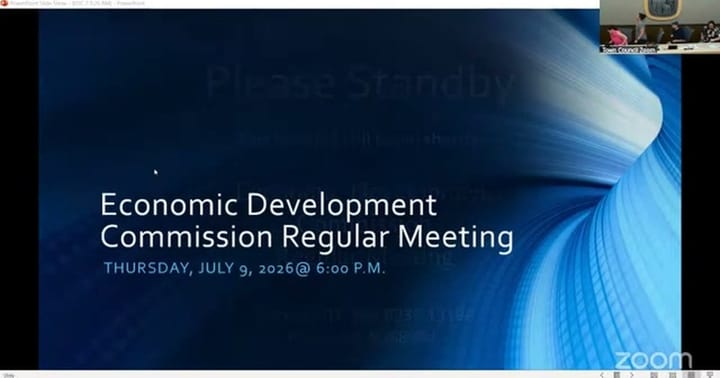
Other Committee · Meeting of July 9, 2026
NEWINGTON — The Newington Economic Development Commission weighed whether it has authority to form subcommittees, after a town official flagged conflicts in its bylaws adopted in 2008. A town official identified only as James told members their 2008 bylaws, which list a defunct meeting address, claim subcommittee powers that belong solely to the Town Council under the charter. Commissioner Forsellini pressed on what triggered the review, which stemmed from commissioners' use of outside email.
James said any communication among the board's five-member quorum discussing commission business could be ruled an improperly posted meeting under state Freedom of Information law. "So there would still be at least what I'll call a two month process," James said of any council ordinance change. The commission also voted unanimously to name commissioner Jennifer as Chamber of Commerce liaison and to add a recurring business-openings-and-closings report.
In the full story:
- Governance Briefing: Statutory Authority, Bylaws and FOI Compliance
- Chamber of Commerce Report
- Newington Center Business Collective Report
- Old Business: Fundraising and Budget
- New Business: Chamber Liaison Appointment
- New Business: Plan of Conservation and Development Review
- New Business: Newington Business Brief
- Town Planning Update
- Commissioner Comments
- Who Was There
- Organizations And Documents Referenced
- The complete report: 2,443 words
Source: the Other Committee meeting of July 9, 2026, reported from the official video recording and transcript.
Checked against the record: before publication this article was automatically compared with the meeting transcript. It was corrected where it differed.
The Full Article
Governance Briefing: Statutory Authority, Bylaws and FOI Compliance
Background and stakes: The Economic Development Commission's briefing grew out of a complaint-adjacent concern raised at the prior month's meeting, when two commissioners discussed commission business outside a posted meeting. A town official, identified in the meeting only as James, who handles boards-and-commissions compliance for the town, used the session to walk members through their statutory basis and flag that the commission's current bylaws, last written in 2008, claim authority the commission does not actually have under the town charter.
The question before the body: Whether the commission can create its own subcommittees or working groups to handle business between its single monthly meeting, and if not, what process would let it request that authority from the Town Council.
Substantive content: James told the nine-member commission (with up to three alternates currently appointed, out of a possible 15 members and unlimited alternates allowed by statute) that its powers flow from Connecticut General Statutes 7-136 and Town Charter Section C606, which created the commission, and Section 610, which reserves to the council the authority to create boards, commissions and subcommittees by ordinance. He noted the commission's bylaws, found in Section 11 of the meeting packet, assert a power to create subcommittees that statutorily belongs only to the council. He also pointed out that the bylaws, unrevised since 2008, list the commission's address as 131 Cedar Street, "which doesn't exist anymore," and that the public-participation period in the bylaws is three minutes, not the two minutes printed on the current agenda. Any membership change, such as reducing the board from nine members and three alternates to a smaller size, would go through the easier-to-amend town ordinance (Chapter 8, Sections 829-831) rather than the charter, which James said takes roughly a 10-year revision cycle.
On the live question of whether commissioners may discuss business outside a posted meeting, James explained the quorum threshold: five of the nine members constitutes a quorum. Communication, written or oral, among fewer than a quorum generally does not trigger Freedom of Information Act posting requirements, but any exchange that reaches a quorum and discusses commission business, even informally, can be ruled an unposted meeting. He cited the specific language from the town's boards-and-commissions booklet, page 11: distributing information outside a meeting "is not considered deliberation, so long as the material or information does not express any opinions of a committee member." A commissioner who asked whether an email he sent the full committee ahead of the meeting, outlining proposed future agenda topics, was appropriate was told it was fine as a one-way informational note, but that soliciting responses back from a quorum would create what James called "an online deliberation."
The deliberation: Commissioner Forsellini pressed on the origin of the discussion, asking directly whether the only impetus was concern over commissioners' use of outside email addresses. James confirmed that was the trigger, explaining the town wants to ensure records of commissioner communications are preserved and accessible under FOI, and is exploring setting up a managed town email address for commissioners. He added that the town does not want commissions "going sort of outside of the organization," since members are council appointees rather than an independent board.
Forsellini then raised a specific scenario from the prior month, in which two commissioners met to discuss how the commission could better support itself outside the formal meeting. James called this "a very gray area": because two people fall below the five-member quorum, it likely does not rise to a posted meeting, but any formal, standing subcommittee of five or more would. A council liaison present at the meeting, identified as Gail, asked why the commission could not simply form "a working group" rather than go through a formal subcommittee process; James said he would raise the question specifically with the state Freedom of Information Commission's education officer and separately consult the town attorney, since the answer depends on how much latitude the council has delegated. He floated one possible model: the council could authorize the chair to create up to three standing, project-based subcommittees — for example, one on the Berlin Turnpike corridor and one on downtown development — with rotating membership approved by the full commission for each project, rather than creating a new subcommittee each time a topic changes.
"So there would still be at least what I'll call a two month process," James said, describing the sequence: the commission would bring a written proposal to the council, which would decide whether to introduce an ordinance amendment, schedule a public hearing, hold the hearing, and then act.
Procedural steps and outcome: No motion was made or vote taken on subcommittee authority. The commission agreed informally to let James consult the Freedom of Information Commission and town attorney, and to revisit the topic, along with a broader bylaws update, at next month's meeting. Staff liaison Eric was asked to add to next month's agenda an "added discussion of identifying what subcommittees we would have," framed as either a bylaws subcommittee or an economic-development/POCD-focused working group depending on the FOI guidance received.
Implications and what is next: Until the council acts, the commission's ability to divide labor between meetings remains limited to informal contact among fewer than five members, with any broader coordination required to occur in a posted meeting. The bylaws review and subcommittee question are both now slated for the commission's August meeting.
Chamber of Commerce Report
Background and stakes: The commission receives a routine update from the Greater Newington Chamber of Commerce as a standing agenda item.
Substantive content: A chamber representative reported a June 24 car show that had to be moved due to rain but was well attended, and a July 1 networking event at PC Richards that drew more than 30 attendees. The chamber is planning to track monthly website and social-media analytics to gauge engagement, and is considering reviving a "Hidden Business Open House," last held in September 2023, highlighting home-based and non-storefront businesses, sometimes called cottage industries. The chamber's signature Golf Tournament is scheduled for August 3, with organizers seeking golfers, sponsors and raffle prizes. Three new chamber members were named: Northeast Gutters and Remodeling, Blastenberry Electronics Recycling, and One Stop Lending. A second chamber representative, referred to in the meeting as Jim, said the chamber is building a stronger base of licensed trade professionals, such as plumbers and electricians, alongside home-based businesses it hopes will eventually grow into storefronts.
Outcome: No vote; informational report.
Newington Center Business Collective Report
The collective reported a summer decorative "wings" theme downtown as part of a Newington Center promotional campaign, including a mural at Stay True and new flower beds at Not a Faze Cafe, running through roughly the end of August. The group said it has filed its bylaws and will next pursue federal 501(c)3 nonprofit status. No vote was taken.
Old Business: Fundraising and Budget
The commission closed out a standing fundraising-and-budget discussion item, with members confirming the relevant budget cycle had concluded and no further action was needed. The item was removed from future agendas.
New Business: Chamber Liaison Appointment
Background and stakes: Commissioners had discussed designating a chamber liaison the prior month without formally selecting one.
Procedural steps and outcome: A commissioner moved to formalize commissioner Jennifer as the commission's Chamber of Commerce liaison; the chair called for additional nominations, received none, and a motion was made and seconded. The commission approved the appointment by unanimous voice vote.
New Business: Plan of Conservation and Development Review
Background and stakes: A commissioner, referred to in the meeting as Todd, told the commission he had circulated, through staff liaison Eric, copies of two sections of the town's Plan of Conservation and Development identifying the commission's responsibilities. He described himself as recently retired after 15 years as a municipal economic/community development administrator and 20 years at Goodwin University working on workforce development, real estate development and brownfields revitalization.
The question before the body: Whether to add a recurring agenda item reviewing the EDC's responsibilities under the POCD and identifying priority initiatives.
Substantive content: Todd pointed to Section 9 of the plan, pages 55 and 56, which he said lists nearly a dozen strategies where the EDC is named lead partner, and to several "opportunity areas" and individual opportunity sites identified in the plan, including the town center and the Cedar Street fast-track transit station, both of which he said have seen progress, plus other sites he said merit a fresh look for redevelopment potential. He noted the current plan runs through 2030 and that the town will begin work on its next plan in a few years.
The deliberation: Todd said he did not expect deep discussion that night but wanted to introduce the topic and pose questions for commissioners to consider individually before the next meeting, specifically asking them not to discuss the material among themselves beforehand given the quorum concerns raised earlier in the meeting. He connected the review to the town's fiscal pressure, citing recently issued tax bills and noting that growing the town's taxable "grand list" through responsible development could help offset the burden shifted to residents. He cited the Hartford Hospital property as a notable tax-exempt parcel and said other underutilized or blighted properties in town could be targets for redevelopment that would add to the tax base.
"I don't think we need a vote on it, but it has my support for the agenda," one commissioner said.
Procedural steps and outcome: No formal motion was required; staff liaison Eric agreed to add "POCD Review" as a running item under old business, similar to how the commission has tracked its ongoing Passport Program item, until the question of whether a formal subcommittee or informal working group handles the work is resolved.
Implications and what is next: Commissioners are expected to review the packet materials individually and discuss specific priorities at the August meeting.
New Business: Newington Business Brief
A commissioner proposed adding a recurring item, the "Newington Business Brief," compiling a monthly list of business openings and closings in town, drawn from information she said she tracks in part through contact with Connecticut Scoop and Newington Scoop. A motion to add the item was made, seconded, and approved by unanimous voice vote.
Town Planning Update
Staff liaison Eric reported an error in newly ordered commissioner business cards, which mistakenly included his own email address, and said corrected cards are expected by next meeting. He noted recent interest in the Newington Meats property. He confirmed Town Planner Paul's last day is next Tuesday, that the town planner position has already been posted, and that he expects to serve in an acting role in the interim. On the Keeney project, Eric said he has not heard from the developer and no formal application has been submitted; potential zoning amendments remain a possible path forward. He also briefed the commission on a new state "middle housing" law effective July 1, 2026, requiring municipalities to allow two-to-nine-unit housing in commercially zoned areas; Newington has updated its regulations to comply. Eric said the town currently holds "Safe Harbor" status under the state's 8-30g affordable-housing statute, having exceeded the 10 percent affordable-housing threshold, which shields it from certain override applications, though he cautioned that status is not permanent.
Commissioner Comments
One commissioner described attending the Main Street Connecticut conference in Torrington roughly three weeks earlier, which focused on preserving institutional knowledge across economic-development and Main Street organizations as membership rotates. Commissioners Jim and Deanna reported on a June 23 downtown planning committee meeting, also attended by town council liaisons, that focused on how to begin spending previously granted state funds for downtown improvements. They said early discussion favored visible, tangible investments, a traffic and parking study for the Cedar Street/downtown area, prominent "Market Square"-style signage, and public art such as benches, over spending that residents would not see. They noted a plan must be submitted before funds are released and that timeline requirements apply to how the money is used. They said Town Planner Paul has been leading the effort and that the commission will need to bring his successor up to speed. No further meeting of that committee is currently scheduled.
WHO WAS THERE
- Commissioner Forsellini: member, asked questions on FOI and subcommittee authority.
- Commissioner Lucas: member, participated remotely by phone.
- Commissioner Jennifer: member, formalized as Chamber of Commerce liaison.
- Commissioner Todd: member, introduced POCD review proposal.
- Commissioners Jim and Deanna: members, reported on June 23 downtown planning committee meeting.
- Allen: attended online during the public-participation portion; role in meeting unclear.
- Gail: Town Council liaison to the commission.
- Matt Lord: Town Council liaison to the commission (also referenced as "Matt").
- James: town staff member who briefed the commission on statutory authority, bylaws and FOI compliance.
- Eric: staff liaison to the commission, expected to assume an acting town-planning role.
- Paul: Town Planner, departing; last day the Tuesday following the meeting.
- Chamber of Commerce representative and a representative referred to as Jim: gave the chamber report.
- Newington Center Business Collective representative: gave the downtown-collective report.
ORGANIZATIONS AND DOCUMENTS REFERENCED
- Town of Newington Boards and Commissions Booklet (last amended August 2023): cited repeatedly by James as governing meeting procedure, communications and FOI compliance.
- Town Charter, Sections C606 and 610: cited as the source of the commission's creation and the council's exclusive authority to create subcommittees.
- Connecticut General Statutes Section 7-136: cited as the statutory basis for municipal development commissions.
- Town Ordinance, Chapter 8, Sections 829-831: identified as the section that would need amendment to authorize EDC subcommittees.
- State Freedom of Information Commission: James said he would consult its education officer on the legality of small working groups below quorum.
- Plan of Conservation and Development (through 2030): cited by commissioner Todd, Section 9, pages 55-56, as listing EDC-led strategies and opportunity areas.
- Connecticut Scoop and Newington Scoop: cited as sources for the proposed "Newington Business Brief" monthly listing.
- Greater Newington Chamber of Commerce: gave monthly report; organizing August 3 golf tournament.
- Newington Center Business Collective: gave monthly report; pursuing 501(c)3 status.
- Main Street Connecticut: statewide organization whose Torrington conference a commissioner attended.
- June 23 downtown planning committee meeting: referenced by commissioners Jim and Deanna regarding spending plans for state downtown-improvement grant funds.
- New state "middle housing" law (effective July 1, 2026): cited by Eric regarding required zoning allowances in commercial districts.
- Connecticut General Statutes Section 8-30g: cited regarding the town's "Safe Harbor" affordable-housing status.
Share this story
Know someone in Newington who follows town government? Share Townbrief Newington: they can sign up free.